





The discussion about concentration in artificial intelligence markets focuses on the least concentrated layer, the models. The chokepoint that actually threatens AI is the production of refined minerals that go into chips, data centers, and electricity production, writes Piyush Akimitsu.
The discussion about market concentration in artificial intelligence makes a costly omission by focusing on foundational models and the cloud. A host of open- and closed-weight models are being released on a regular basis. Most of these models come from the United States. However, a good number like Deepseek and Moonshot’s Kimi K3 come from China. Data on concentration at different levels of the AI stack, which I organized into a public dashboard, shows the model market has a Herfindahl-Hirschman Index (HHI) of about 494. According to the most recent U.S. Merger Guidelines, this index score places the model market on the lower range of moderate concentration. High concentration begins at 1,800. Cloud computing, upon which these models rely, is rented from a few firms. Amazon, Microsoft and Google hold about 63% of the market, but the market is still only moderately concentrated.
Figure 1. Concentration by layer of the AI stack
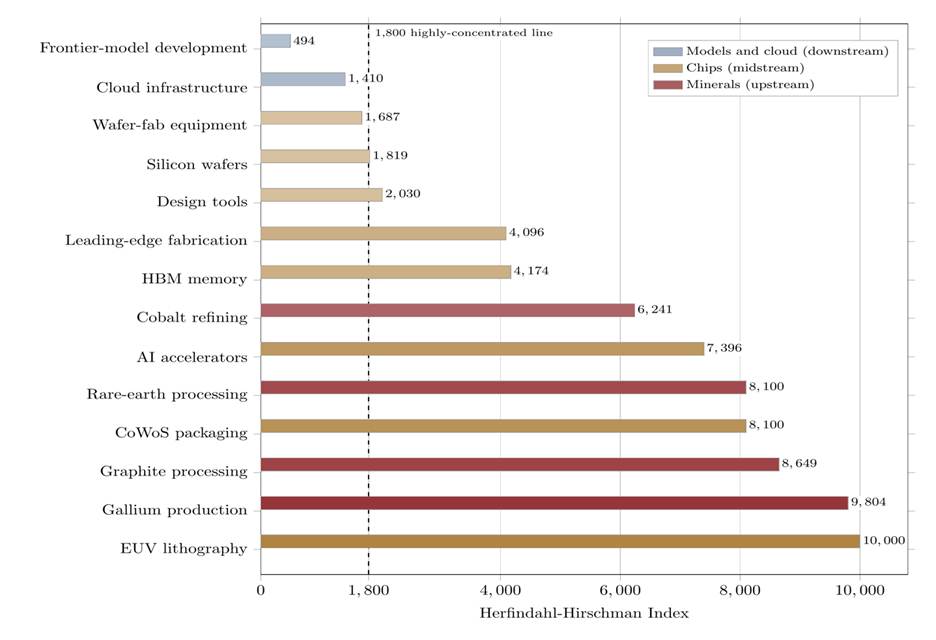
The most problematic concentration is occurring among chip manufacturers and mineral sources (the latter determined by country of origin). In chip-design software, firms such as Synopsys, Cadence and Siemens control about 74% of the global market. Nvidia produces 86% of accelerator chips needed for the complex math that is used to train AI models. Taiwan Semiconductor Manufacturing Company Limited (TSMC) produces 90% of the advanced packaging to integrate the logic and memory onto working chips. Shin-Etsu, SUMCO, GlobalWafers, Siltronic and SK Siltron are responsible for 90% of the polished silicon wafers used in advanced chips. Lastly, ASML of the Netherlands is the sole supplier of extreme-ultraviolet (EUV) lithography, the process of printing the finest of the circuits onto the chips.
The high concentration of the specialized chips markets poses a serious problem for competition authorities, but from the perspectives of trade and national security, it is of less concern to the U.S., as these companies are mostly American or of a nationality allied to the U.S.: Japanese, Taiwanese, German, and Dutch. Minerals are concentrated in less reliable countries, particularly China, making this a unique conundrum for U.S. policy. Unreliable mineral sourcing threatens the U.S. AI production chain. It also does so unequally, and if trade were to be disrupted, it would impact America’s largest tech companies disproportionately less, as these companies are building out and stockpiling their own resources. Though minerals pose a competition problem, the solution lies in trade and industrial policy.
Concentration in minerals
Minerals are crucial for both the chips and the data centers that power AI. Minerals are also essential to the energy production that feeds AI’s supply chain. In 2023, data centers consumed about 4.4% of the total electricity in the U.S. and this is projected to rise to 12% by 2028. Minerals are needed for both renewable and non-renewable energy sources. For example, wind turbines need rare-earth magnets, solar panels need silicon, and gas turbines need cobalt and nickel.
A few countries hold the geological reserves and the mining and refining capabilities for these minerals. China processes about 99% of gallium, which is used in the circuits that deliver power to the chips at the right voltage. China also produces 87% of the silicon which forms the base of all chips. In addition, China refines about 90% of all the rare-earth metals that are used in the magnets of motors used in the cooling fans and pumps in the data centers. China also produces 79% of tungsten, which is used in AI chips as the contact plugs and vias that connect transistors to the metal wiring layers.
Another crucial metal is cobalt, which is used in gas turbines and lithium-ion batteries used for backup power. Cobalt is mined mostly in the Democratic Republic of the Congo, and China refines 79% of it. Moreover, China refines about 93% of graphite, which is used in battery banks that protect the AI data centers from grid outages. Last but not least, copper is used in busbars, switchgear, and cables. A new data center drawing a gigawatt of power would need about 27,000 tonnes of copper. Even though copper mines are spread across countries such as Chile, Peru and others, half of copper is still refined in China.
The U.S. imports nearly 100% of its gallium and natural graphite, 70-80% of its rare-earth metals, and about 76% of its cobalt. The trace of these metals in many of the individual products that comprise the AI ecosystem is small, and the minerals seem affordable. However, the fact that most of the sources of these minerals lie in geological reserves, mines and refineries in a few countries that do not have close ties to the U.S. poses a risk to the resilience of the U.S. AI supply chain.
U.S. mineral supply chains are at risk.
The U.S.’ dependency on China for minerals is already jeopardizing its AI supply chains. In response to U.S. controls on chip exports, China put gallium and germanium under export licensing in 2023. In December 2024, after the U.S. expanded those controls, China banned direct shipments to the U.S. Between 2021 and 2024, the U.S. imports of germanium fell by 68% and those of gallium by 77%.
China’s trade data reported no exports of either metal to the U.S. in 2024. However, the U.S. still recorded 26% of its germanium and 8% of its gallium imports as having arrived from China. This is due to imports rerouting through third countries to avoid controls. For example, China’s exports of germanium to Belgium rose by 224% between 2022 and 2024. On the other hand, Germany’s share in U.S. imports of gallium rose more than tenfold.
Thus, consumption of neither metal has fallen in the U.S. so far. However, stockpiles of germanium helped cushion some of the reduced imports. There are no such stockpiles for gallium, hence it is more vulnerable to such trade shocks. The U.S. Geological Survey estimates that if the rerouting channel is closed, domestic gallium prices could rise by about 150% and germanium prices by 26%. This would upend the AI supply chain and shrink U.S. GDP by about $3.4 billion.
In November 2025, as part of a trade truce, China temporarily suspended its ban on gallium and germanium exports to the U.S. Instead, sales are case by case with a continued blanket ban on sales to U.S. military end-users. The suspension is set to expire in November 2026.
How the mineral bottleneck impacts competition
The precariousness of minerals and the consequential risk it poses to the AI supply chain has pushed U.S. firms to acquire more dependable input sources. Large companies are best placed to acquire these resources and the energy and computing power they produce. For instance, Microsoft recently signed a 20-year contract to restart the Three Mile Island nuclear power plant for its data centers. Amazon has a contract of 1.92 gigawatts with Susquehanna nuclear power plant through 2042. Google has ordered small modular reactors, though these will not generate electricity until 2030 at the earliest. These large firms can buy a power plant’s output well in advance. They can also place the large, multi-year orders that claim the scarce turbines and transformers, securing not just the power but also the equipment to build the sites. If U.S. mineral supply chains are cut off, the largest AI companies will be least affected.
Dealing with the chokepoints
The U.S. has two levers to address its mineral chokepoints and lessen its potential impact on competition, and ironically neither is competition policy. These levers are trade policy and industrial policy.
China is the largest producer and refiner of rare-earth minerals, but plentiful reserves exist elsewhere. Brazil, for example, holds the second-largest reserve of graphite and rare earths. Australia has access to tungsten and cobalt. Despite their resource endowment, both countries produce below their potential. This is due to a lack of mining and refining capacity. The U.S. could revise its trade policy to encourage allies and more dependable countries with material reserves to develop mining and refining capabilities. This can come in the form of foreign investment opportunities or trade negotiations. The U.S. could also build out its own refining infrastructure so that it reshores critical parts of the mineral production chain, reducing what it depends on other countries to provide and what it would require allied nations to build to produce minerals ready for use further down the AI supply chain.
The case of gallium sheds some light on how practical this can be. Gallium is found dissolved in the same alumina that refineries in Germany, Greece, Australia and Ireland already produce. However, today it is simply discarded because recovery is not financially viable. Thus, recovering it doesn’t need a new mine but only a retrofit of a refinery that is already running. That would make building a gallium recovery plant feasible within three years.
Indeed, Germany, Hungary and Kazakhstan used to produce gallium, but their industries died out when China flooded the market with more cheaply produced minerals. Ironically, China’s recent export controls caused a supply shortage, which caused gallium prices to rise so much that, by 2026, buyers outside China started paying about $2,100 a kilogram against $250-265 before the controls went into effect. Germany’s Stade refinery, which stopped gallium production in 2016, is planning to restart its operations by 2027 with a capacity of about 40 tonnes per year. Kazakhstan is presently recovering gallium at its Pavlodar plant and has a sale agreement with Mitsubishi in Japan. METLEN in Greece is building its gallium plant, slated to start production from 2027 in Agios Nikolaos with a capacity of 50 tonnes a year, financed partly by the European Investment Bank. In addition, Alcoa, the American aluminum producer, is adding a gallium recovery plant at its Wagerup refinery south of Perth with a capacity of about 100 tonnes per year. The project has Japanese partners and the support of the governments of Australia and the U.S.
The diversification of gallium production will depend on an internationally maintained price floor. The U.S. can help supply this floor, at least for domestic production, by guaranteeing the cost of recovery and a fair return or helping to finance domestic recovery plants. For example, in July 2025, the Pentagon signed a ten-year deal with MP Materials that set a floor of $110 a kilogram for neodymium-praseodymium products, took an equity stake, and agreed to buy the plant’s entire output. The U.S. could make similar deals with producers in allied countries. It could also institute antidumping duties that stymie Chinese efforts to flood the market and drive out competition, helping to support the global market.
As the case with MP Materials shows, the U.S. has access to some of these mineral reserves but has not yet encouraged the widespread mining of them. Gallium and silicon are not really scarce. Gallium occurs in bauxite, which is mined commonly. Silicon is smelted from ordinary quartz. Yet the U.S. produces no primary gallium and imports all of it, despite its bauxite base, while it already makes more than half of its own silicon.
Some of the minerals also have substitutes more readily accessible to U.S. industry. For instance, cobalt-free batteries that use lithium iron phosphate already comprise a major share of the electric vehicle battery market. The U.S. is self-sufficient in iron and phosphate.
However, rare earths don’t have good substitutes, and neither does tungsten. A ferrite magnet could replace the rare-earth magnet, but it is only a tenth as strong. Thus, for rare earths and tungsten, U.S. industrial policy could emphasize stockpiling minerals similar to what it does with the Strategic Petroleum Reserve. That way, if there were to be disruptions to the mineral supply chain, the U.S. could manage prices and access in the short term.
The Competition that Matters
Materials represent one of the most concentrated segments of the AI production chain, but there is little competition policy can do in this regard. Most critical production and refinement of materials is currently based on China, creating a particular risk that comes from the U.S.’ dependency on a geopolitical rival for key segments of AI industry. To protect the most important market today, the U.S. must rethink its trade and industrial policy to diversify its sourcing and build a more resilient mineral supply chain. The failure to do so will harm the AI market, and those that best weather any shocks will be the largest firms that are already diversifying and building out their own energy and computing infrastructure.
Author’s note: This article has a companion paper, Artificial Intelligence: Supply-Chain Chokepoints and the Reach of Industrial Policy, and a public dashboard with all sources and methods at aistackmap.org and archived at Zenodo. The dashboard is updated as new source data is released, so the figures in this article are a snapshot as of August 2026.
Author Disclosure: The author reports no conflicts of interest. You can read our disclosure policy here.
Articles represent the opinions of their writers, not necessarily those of the University of Chicago, the Booth School of Business, or its faculty.
Subscribe here for ProMarket’s weekly newsletter, Special Interest, to stay up to date on ProMarket’s coverage of the political economy and other content from the Stigler Center.