










In a new paper, Joseph Emmens, Dennis C. Hutschenreiter, Stefano Manfredonia, Felix Noth, and Tommaso Santini find that when competitors for the same pool of workers share investors, they increase their innovation to automate tasks and slow down hiring.
Common ownership arises when the same institutional investors—index-fund giants such as BlackRock, Vanguard, and State Street, alongside pension funds and other large asset managers—hold meaningful stakes in several firms at once. These firms are often direct competitors. The overlap in ownership among publicly traded firms, within and across industries, has grown dramatically in recent decades, as documented by prior literature.
Most of the debate about common ownership has focused on prices. A prominent line of research argues that when rivals share owners, they compete less aggressively in product markets, nudging prices upwards. We ask a different question: does common ownership change a firm’s choice to automate tasks? This complements a broader literature on how large investors affect the overall level of firms’ innovation. The starting point is a standard idea in corporate finance: well-governed managers act in the interest of their shareholders. When those shareholders also own a competitor, the firm begins to weigh that competitor’s profits alongside its own.
We show that common ownership changes how firms innovate. When common ownership rises among companies hiring from the same local labor pool, they tilt their research toward automating tasks rather than launching new products, and their employment growth slows. The pattern disappears when commonly owned firms operate in separate labor markets, a fact that directly isolates the mechanism we propose.
The mechanism: internalizing a rival’s wage bill
Our model, built using the task-based framework of Daron Acemoglu and Pascual Restrepo, makes the logic precise. Consider two firms that hire from the same local labor market which we define to be within the same commuting zone. When one firm expands its workforce, it pushes up local wages, raising labor costs not only for itself, but for its competitors. Ordinarily, a firm ignores the burden it places on a competitor. But if its owners also own that competitor, hiring more workers now eats into the owners’ profits.
One way to relieve that pressure is to demand fewer workers in the first place. So, as common ownership among labor-market rivals deepens, firms gain a stronger incentive to develop labor-saving technologies and to slow their hiring. We derive from this model a sharp prediction: the effect proposed should appear only when firms actually compete for the same workers. If two commonly owned firms operate in different regions, one’s hiring does not move the other’s wages, and common ownership should not drive automation.
Testing it with patents, establishments, and investor mergers
We test this with data on employment in the United States by combining several sources: institutional holdings from regulatory filings, firm financials, the geographic map of firm establishments, and patents classified as “automation” or not using a text-based method developed by Katja Mann and Lukas Püttmann. Mapping establishments to commuting zones lets us see which firms compete for labor.
A simple correlation between common ownership and automation would be hard to interpret. Firms that automate may also be more innovative, more profitable, or more attractive to institutional investors. To isolate and plausibly measure the impact of common ownership, we examine mergers between institutional investors. When two asset managers combine, the firms in which they have large ownership stakes suddenly share a single owner, an increase in common ownership that is not driven by the individual firm strategies. Drawing on a set of such mergers between 1990 and 2010 and a modern dynamic difference-in-differences method, we trace what happens after the merger takes place. The crucial step is that, because we know where firms employ people, we can separate mergers that likely raise common ownership among labor-market rivals from those that raise it among firms in different regions—precisely the contrast our model identifies.
What we find
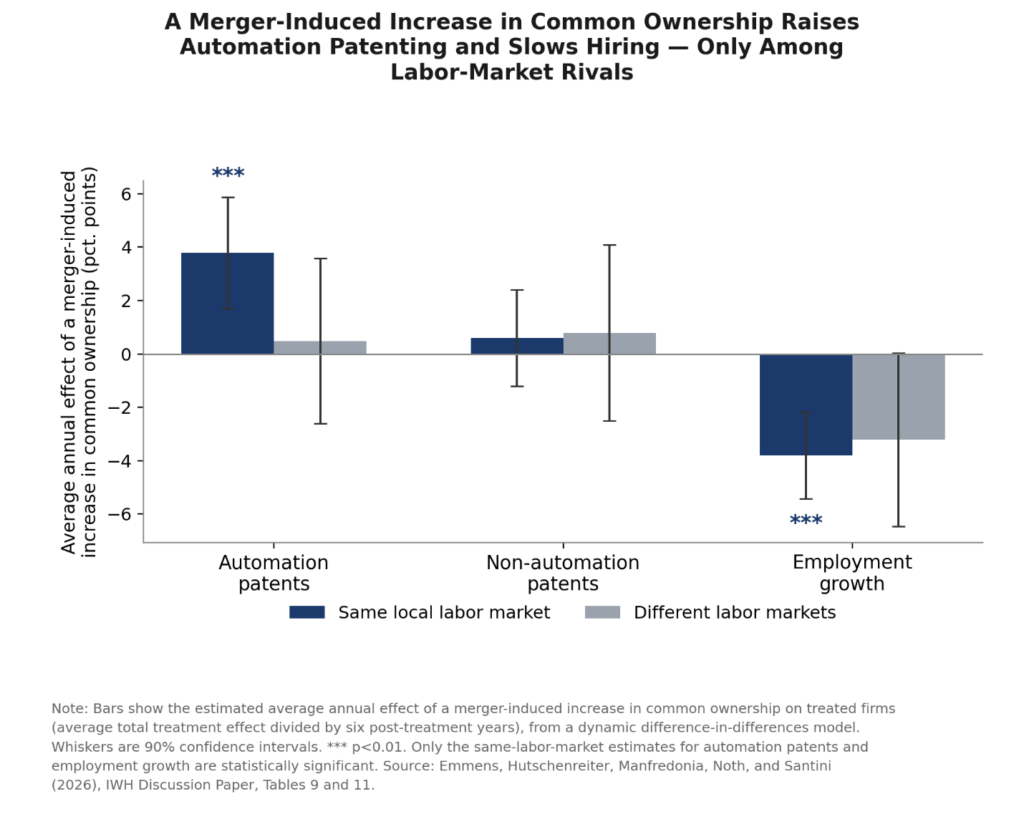
When common ownership rises among local labor-market rivals, a firm’s chance of producing an automation patent in a given year increases by about 3.79 percentage points—roughly a nine percent rise over the baseline rate of 43 percent. At the same time, employment growth slows, falling by about 3.8 percentage points per year.
Both effects vanish when commonly owned firms do not share a labor market. Common ownership spurs automation only when the labor channel is active—consistent with the wage channel, rather than a general increase in technological investment, driving the result. A story in which investor mergers simply anticipate firms that were about to automate anyway would predict more automation in both cases. We see it in only one.
The redirection is specific. The extra patents are concentrated in process innovations that retool the production line to make existing goods with less labor, not in new automation products such as household robots. That is exactly what a wage-bill motive predicts. And non-automation patenting does not rise, so firms are not simply innovating more across the board. They are steering innovation toward replacing labor. These findings hold up under alternative definitions of the treatment variables (continuous and discrete treatment), and in a version that stops before the 2007 Financial Crisis, which excludes the famous BlackRock-BGI merger. The following chart summarizes our main results:
Why it matters
Daron Acemoglu, Andrea Manera, and Pascual Restrepo have argued that the U.S. may already automate excessively—adopting “so-so” technologies that displace workers without delivering large productivity gains, partly because the tax code favors capital over labor. Our results add a new driver to that list: who owns the firm. Automation undertaken to hold down a co-owned rival’s wage bill, rather than to capture genuine efficiencies, can worsen the trade-off between technological progress and the labor market, dragging on wages, employment growth, and labor’s share of income.
The implication for policy is straightforward. Scrutiny of common ownership has centered on consumer prices and product-market competition. Our evidence suggests regulators should also weigh its effects on labor markets and on the direction of technological change. As common ownership keeps climbing on both sides of the Atlantic, what it does to workers—and to the kind of innovation firms pursue—deserves a place in the conversation.
Authors’ Disclosures: The authors report no conflicts of interest. Joseph Emmens gratefully acknowledges funding from the Spanish Agencia Estatal de Investigación (PID2020-114251GB-I00); Dennis C. Hutschenreiter gratefully acknowledges support from the Generalitat de Catalunya (2021 SGR 00194). The authors report no competing financial interests related to this work.You can read our disclosure policy here.
Articles represent the opinions of their writers, not necessarily those of the University of Chicago, the Booth School of Business, or its faculty.
Subscribe here for ProMarket’s weekly newsletter, Special Interest, to stay up to date on ProMarket’s coverage of the political economy and other content from the Stigler Center.